ELECTRON CONFIGURATION
regular electron configuration
abbreviated electron configuration
ion configuration
arden gagnon
nixon third hour
CLICK HERE FOR AN EXAMPLE
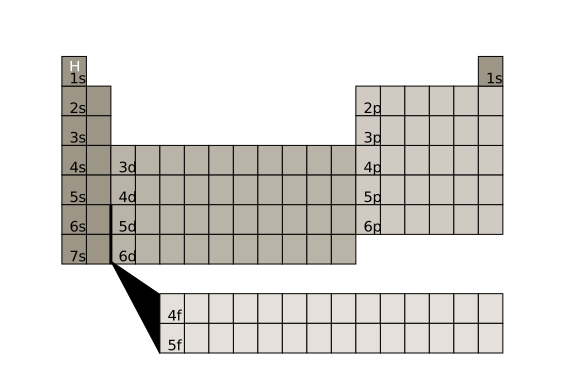
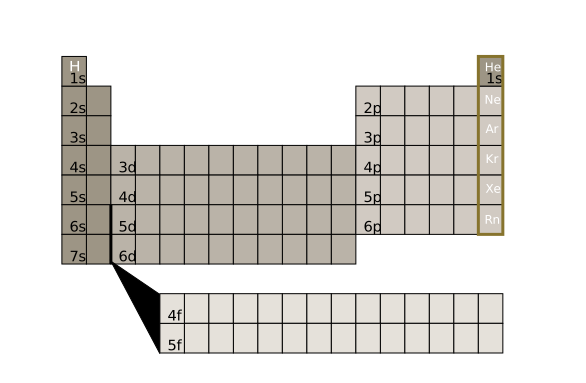
To write the electron configuration for any element, you must utilize the periodic table and the blocks/sublevels that make it up.
Start from hydrogen (1s¹) and move left to right down the table.
Once you enter a new sublevel, record the electrons gained over the number of elements within the block. To record that, write the energy level (the period), the block (s, p, d, f), and the number of electrons (one per element as you move) - in that order. Keep moving across the table until you reach your element of focus.
If you're not sure what is to be recorded, keep in mind the possible number of electrons in each sublevel.
| BLOCK | NUMBER OF ORBITALS | ELECTRONS POSSIBLE PER ENERGY LEVEL |
|---|---|---|
| S | 1 | 2 |
| P | 3 | 6 |
| D | 5 | 10 |
| F | 7 | 14 |
HOME
SULFUR;ATOMIC NUMBER 16
Start from H, in the first energy level and the s block and record all 2 electrons from hydrogen and helium as 1s².Move right from Li in the second energy level and the s block and the 3p⁴ and record all 2 electrons from lithium and beryllium as 2s².Move right from B in the second energy level and the p block and record all 6 electrons from boron, carbon, nitrogen, oxygen, fluorine, and neon as 2p⁶.Move right from Na in the third energy level and the s block and record all 2 electrons from sodium and magnesium as 3s².Move right from Al in the third energy level and the p block and record the 4 electrons from aluminum, silicon, phosphorus, and sulfur as 3p⁴. Since you have reached sulfur, there are no more electrons to count.
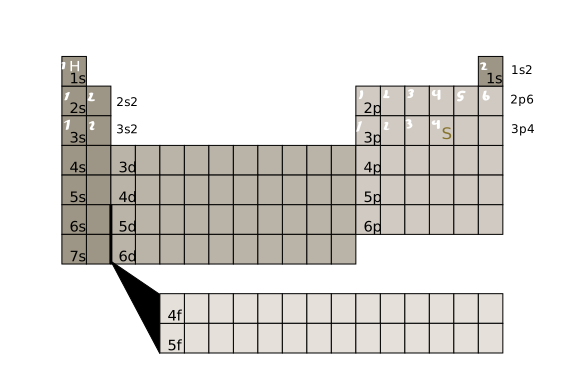
Now that all electrons have been accounted for, put each piece together for the final answer:
1s² 2s² 2p⁶ 3s² 3p⁴
BACK
HOME
CLICK HERE FOR AN EXAMPLE
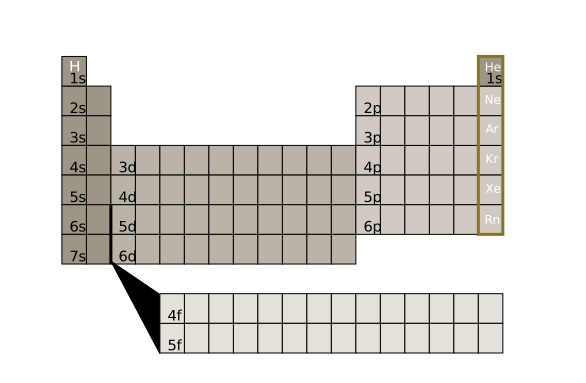
To determine the abbreviated electron configuration for any element, you must utilize the periodic table and the blocks/sublevels that make it up, and most importantly, the noble gases. The noble gases are located in group 8 on the periodic table.
Start by locating your element of focus on the periodic table as well as the noble gas that comes before your element.
Rather than starting at hydrogen as you would for a regular electron configuration, start at the noble gas you just found and follow the same steps as the regular configuration.
Move right from your noble gas until you reach your element of focus and record the electrons in each sublevel.
To write the configuration, put the symbol of the noble gas in brackets and put the remaining electrons outside the brackets.
HOME
BROMINE;ATOMIC NUMBER 35
Start from Ar, which represents 1s² 2s² 2p⁶ 3s² 3p⁶ in the configuration. This becomes [Ar].Move right from Ar, taking you to K, in the fourth energy level and the s block. Record all 2 electrons from potassium and calcium as 4s².Moving into the third energy level of the d block, record the 10 electrons from scandium to zinc as 3d¹⁰. Note that in the d block, the energy level is one lower than that of the s and p blocks.Moving into the fourth energy level of the p block, record the 5 electrons gained from gallium, germanium, arsenic, selenium, and bromine as 4p⁵.Since you have reached bromine, there are no more electrons to count.
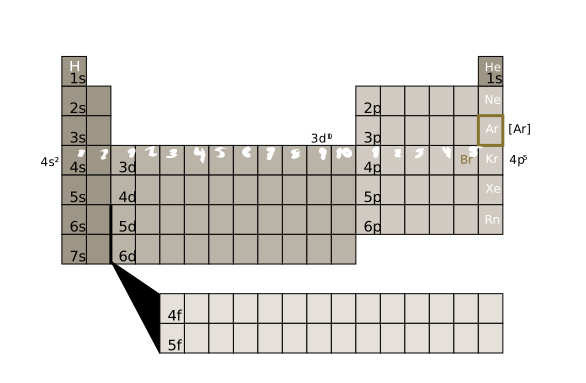
Now that all electrons have been accounted for, put each piece together for the final answer:
[Ar] 4s² 3d¹⁰ 4p⁵
BACK
HOME
CLICK HERE FOR AN EXAMPLE
Ions are formed when elements stabilize themselves by gaining or losing electrons to have completely filled orbitals.
To determine the electron configuration of an ion, you must utilize the periodic table and the blocks/sublevels that make it up, and most importantly, the noble gases. The noble gases are located in group 8 on the periodic table.
Before writing the electron configuration, find the noble gas closest to your element of focus. It may come before or after your element.
Find the distance between your element and the noble gas. This distance will give you the charge of the ion. If you move to the right of your element to reach the noble gas, you are gaining electrons, creating a negatively charged ion, or anion. If you move to the left of your element to reach the noble gas, you are losing electrons, creating a positively charged ion, or cation.
To write the electron configuration, follow the same steps as the regular configuration for whichever noble gas you found.
HOME
ALUMINUM;ATOMIC NUMBER 13
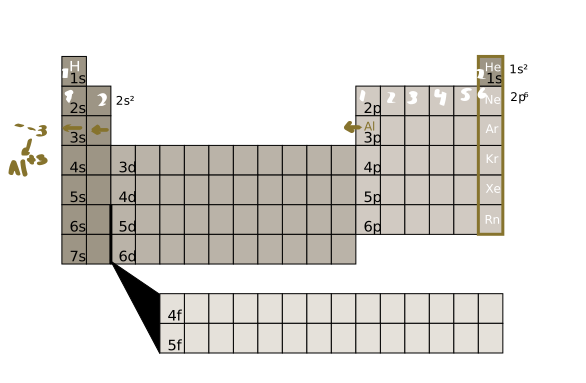
The closest noble gas is neon, which has 3 electrons less than aluminum; this means it loses electrons, causing a charge of +3.
Since the ion formed has the same number of electrons as neon, write the electron configuration as if it were just for neon.
Start from H, in the first energy level and the s block and record all 2 electrons from hydrogen and helium as 1s².Move right from Li in the second energy level and the s block and the 3p⁴ and record all 2 electrons from lithium and beryllium as 2s².Move right from B in the second energy level and the p block and record all 6 electrons from boron, carbon, nitrogen, oxygen, fluorine, and neon as 2p⁶.Since you have reached neon, there are no more electrons to count.
Now that all electrons have been accounted for, put each piece together for the final answer:
Al⁺³ → 1s² 2s² 2p⁶